

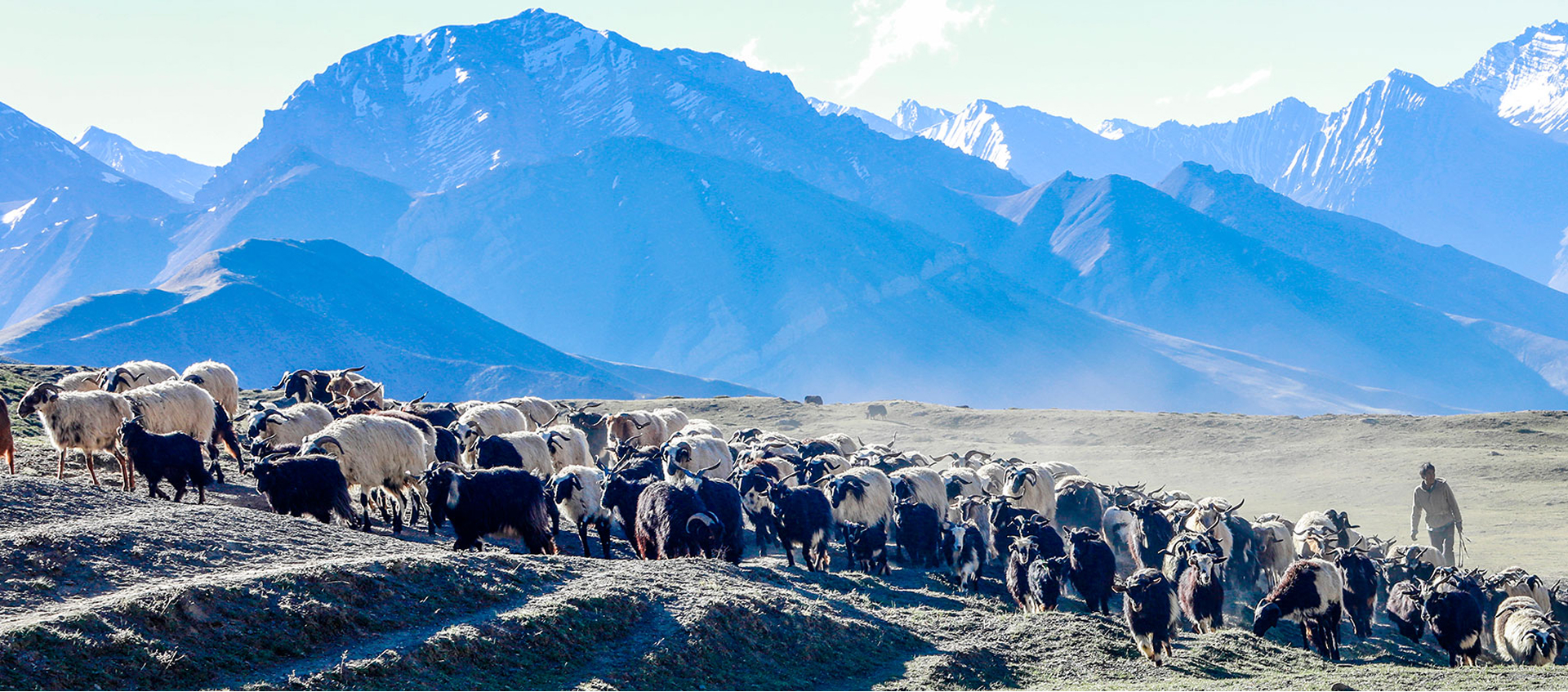
For centuries, the Himalayan Dholpo sheep has evolved in one of the world’s most extreme landscapes: the Upper Dolpo region of Nepal. Nestled deep within the trans-Himalayan plateau, at elevations ranging from 4,000 to 5,000 meters above sea level, this ancient breed has adapted to thin air, harsh winds, and sub-zero winters. Survival in such conditions has shaped not only the sheep, but also the people who have lived alongside them for generations.
Grazing freely across rugged alpine terrain, Dholpo sheep feed on a diverse range of wild medicinal herbs, naturally enriching the character of their wool. This unique diet, combined with the severe Himalayan climate, produces wool renowned for its exceptional warmth, resilience, and natural softness. For centuries, the indigenous Dholpo communities have relied on this wool to craft garments essential for life in freezing conditions-clothing that is not merely worn, but inherited as part of cultural identity.
Traditionally, Dholpo wool is hand-sheared during June and July, when the sheep naturally shed their fleece. This seasonal ritual is carried out with great care, preserving fiber quality while respecting the animal. The collected wool is then prepared for weaving months in advance, ensuring warmth and protection throughout the long Himalayan winter.
In recent years, Gorakhnath Handloom Private Limited conducted field surveys among Dholpo sheep farmers in Upper Dolpo. While these communities hold a deep desire to engage in commercial sheep farming, they face significant challenges: limited access to investment, technical knowledge, and infrastructure. Recognizing both the struggle and the potential, our company began sourcing raw wool directly from these regions while actively supporting local farmers.
Today, we collect authentic Dholpo wool from villages including Mukkot, Chharka, Tinje, Bhijer, and Saldang within the Dolpa District Nepal’s largest district, divided into Lower and Upper Dolpo. Upper Dolpo itself spans elevations from 1,525 meters to 7,751 meters, making it one of the highest inhabited regions on Earth.
The Unique Dimensions of Dholpo Wool:
The Dholpo sheep is among the rarest wool-producing breeds in the world, distinguished by its ability to produce three naturally occurring fiber grades:
• Dholpo Rough Wool: 28–32 microns,
• Dholpo Fine Wool: 22–24 microns,
• Dholpo Pashmina Wool: 16–21 microns.
This remarkable natural variation within a single breed is exclusive to Dholpo sheep, setting it apart globally. The diversity of fiber dimensions allows for the creation of premium tweed fabrics and high-quality rugs with depth, texture, and longevity.
Unlike alpaca and mohair imported from Peru and South Africa. Dholpo wool carries a distinct Himalayan identity. Its origin, texture, and performance clearly differentiate Gorkha GNW tweed and carpets from other products in the global market.
Our Role in the Himalayan Legacy:
Gorakhnath Handloom Private Limited was founded with a commitment to reviving Himalayan wool traditions while building a sustainable future for mountain communities. Sheep farming and woolen Bakhu, Lipcha and Chudhuk weaving have long been integral to Himalayan life, our mission is to transform this heritage into a viable, environmentally responsible industry.
By combining collective sheep farming, traditional hand-loom weaving for fabric products, and modern textile innovation, we work alongside local farmers and artisans to create stable livelihoods and preserve cultural knowledge passed down through generations. Our premium tweed fabrics draw inspiration from traditional Himalayan woolen cloth, blending ancestral craftsmanship with contemporary design.
Each fabric we produce tells a story of land, people, resilience, and tradition. By bringing these textiles to the global stage, we aim to raise awareness of Nepal’s exceptional craftsmanship while contributing meaningfully to the international tweed and textile industries.
As part of our long-term commitment, we aim to directly reinvest 10 percent of our profits in supporting sheep farmers in Upper Dolpo, strengthening sustainable development, and ethical sourcing and community empowerment.